
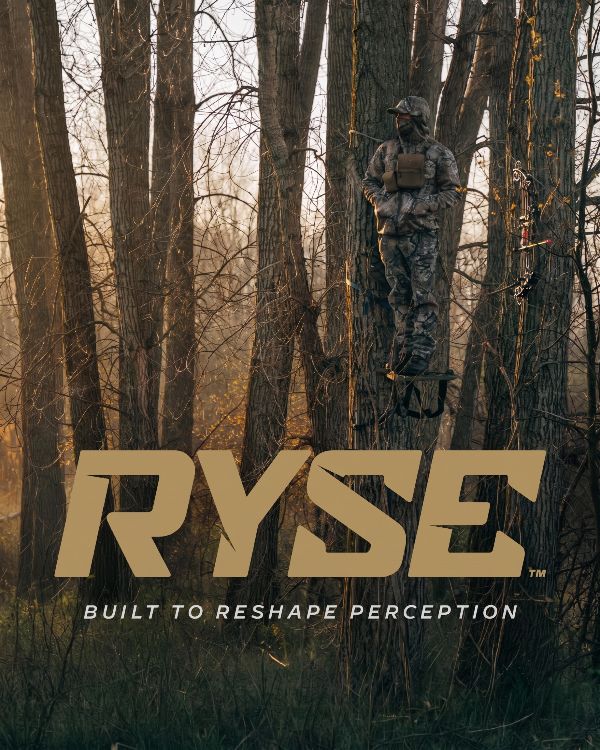
MUSKEGON, Mich. – Whitetail hunters know the woods never sit still. Light moves through the canopy all day long. Shadows shift. Branches cross each other in ways that change by the hour. What looked open at 7 a.m. can look completely different by 10.
Most camo patterns try to freeze that moment. They copy a tree, a leaf, a patch of bark, and hope the woods hold still long enough to match it.
TUO Ryse™ doesn't try to copy the woods. It tries to work inside them.
Breaking the Outline First
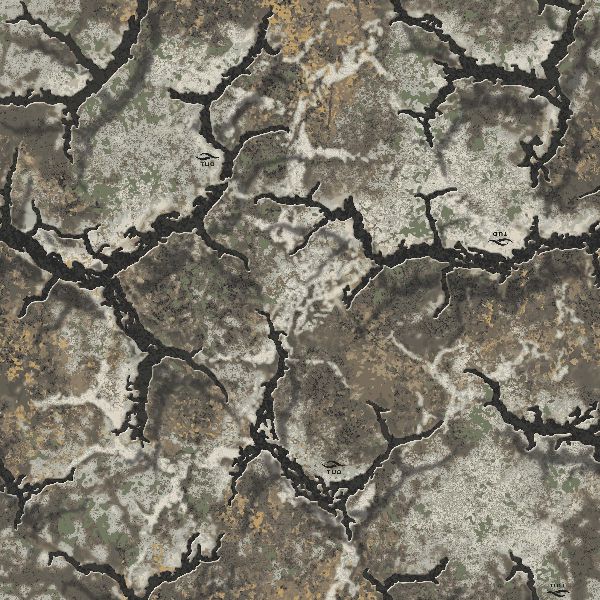
Every camo pattern lives or dies on one job: breaking up the human silhouette. TUO Ryse starts there, with large linear shapes pulled from the bones of a hardwood forest, branches, shadow lines, broken bark, standing timber.
None of those shapes is copying one specific thing, either. That's on purpose. A branch-inspired line can read as a branch, a shadow, or a broken edge depending on where a hunter is standing and how the light's hitting the trees that day. That flexibility is what keeps the pattern working at range, instead of only working in the one spot it was designed to photograph well in.
Then the Details Take Over Up Close
Long-range breakup only does half the job. The other half shows up when a deer's close enough to study what it's looking at.
That's where TUO's Ryse micro layer comes in, fine texture built off weathered bark, moss, leaf litter, the kind of visual noise that softens a pattern at close range without fighting the bigger shapes doing the work from a distance. As a deer moves off, those small details fade into the background and let the larger structure take over, so the pattern doesn't fall apart the moment it's out of arm's reach.
"Some patterns look great in a photo and fall apart the second a deer's standing 15 yards out studying you," said Steve Allie. "TUO Ryse was built to hold up at both ends, right up close and way off in the timber. That's the whole point of layering it the way we did."
The Spaces Between the Shapes
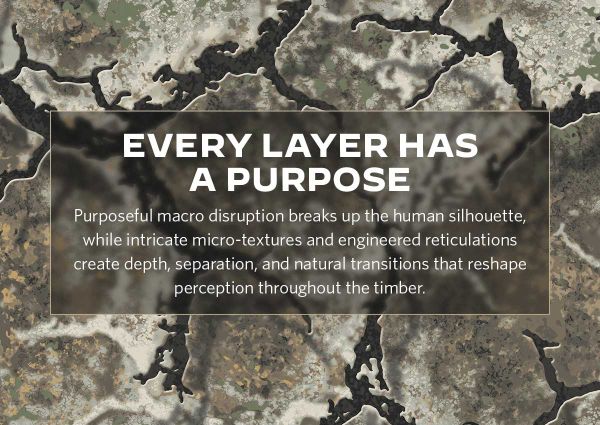
The parts of a camo pattern that get the least credit are usually doing the most work. TUO Ryse leans on a network of reticulations, the fine transitions between its bigger shapes, to keep dark elements from bleeding into one solid mass that reads as unnatural from any distance.
Instead, the pattern holds its depth. Light and shadow keep moving through it the way they move through real timber, instead of collapsing into a flat blob the first time the sun ducks behind a cloud.
A Color Palette That Doesn't Commit to One Season
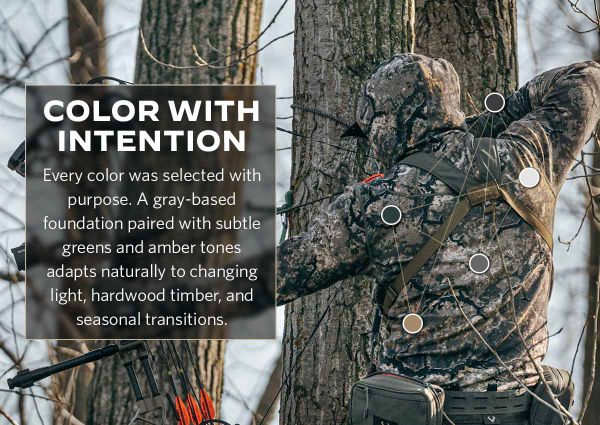
TUO Ryse isn't built around a single tree or a single month, either. It's built around a gray-based midtone that holds up from midseason into late-season, mimicking the hardwoods, muted ground cover, and the gray sky that filters through a bare canopy, then rounds it out with subtle greens and amber accents that shift with the terrain around them.
That's a deliberate call. A pattern locked onto one dominant color looks right for a few weeks and off for the rest of the season. TUO Ryse is built to look right from the first leaves hitting the ground through the final sits of late season.
"We didn't want a pattern that peaks for three weeks in October and then looks out of place," Allie said. "Whitetail season doesn't work that way, so the camo shouldn't either."
Built in Theory, Proven in the Timber
TUO Ryse didn't go straight from a design file to a hang tag. It went through hardwood timber first, tested across shifting light, changing shadow, and the kind of visual clutter that only shows up when you're sitting in a tree instead of looking at a swatch.
That's the difference between a pattern that looks good and a pattern that works. TUO Ryse was built to be the latter.
TUO Ryse™ FEATURES:
- Macro-scale linear shapes drawn from branches, bark, and standing timber to break up the human outline at range
- Micro-texture detailing modeled on bark, moss, and ground cover for close-range concealment
- Reticulated transitions that preserve depth and prevent unnatural dark masses
- Gray-based midtone color strategy with adaptive green and amber accents for early leaf drop through late season
- Field-tested across changing light and shadow conditions in hardwood timber