
The archery (shooting) industry is saturated with products claiming to deliver greater accuracy, tighter groups, or increased range. Yet, few challenge one of the sport’s oldest assumptions: that crafting an accurate sight tape is a matter of trial and error.
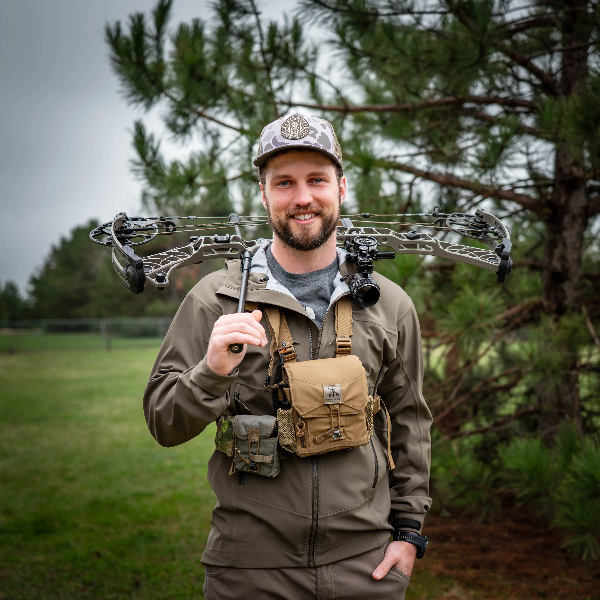
Precision Cut Archery was born from a conviction that there had to be a better approach.
Founder and CEO Tristan Litke fused his expertise as a software engineer with a lifelong passion for bowhunting, developing software that recognizes each arrow and bow as a unique ballistic system. Instead of relying on broad estimates, Precision Cut Archery models every individual setup, producing sight tapes so precise they’re trusted by first-time bowhunters and world champions alike.
But as Litke explains, the heart of the company isn’t software; it’s confidence.
The Hunting Wire recently sat down with Litke to explore the philosophy behind Precision Cut Archery, the science fueling its technology, and why he believes transparent research, not marketing, will ultimately move the sport forward.
Precision Cut Archery isn’t really in the “sight tape business”; it’s in the confidence business. How did that philosophy become the foundation of the company?
Tristan:
“When you come to full draw on an animal, and you see the pin settle where it should, there’s a feeling in that moment when you know it’s a done deal.
“When you come to full draw on an animal, and you see the pin settle where it should, there’s a feeling in that moment when you know it’s a done deal.
Because you know that arrow is going to hit behind the pin. That feeling is what I’ve been chasing since the beginning. First for me, and now for my customers.”
Most archers accept that building a sight tape requires a little trial and error. You rejected that assumption from the beginning. What convinced you there had to be a better way?
Tristan:
“I wouldn’t say I knew there was a better way right away, but I thought it sure seemed like there should be. It didn’t become obvious what that better way was until quite a ways into the experimentation process. There were about six months of working and testing myself before I ever claimed to have built something better. At this point, I have utmost confidence that, with good data, our solutions will be spot on at any distance right away.”
“I wouldn’t say I knew there was a better way right away, but I thought it sure seemed like there should be. It didn’t become obvious what that better way was until quite a ways into the experimentation process. There were about six months of working and testing myself before I ever claimed to have built something better. At this point, I have utmost confidence that, with good data, our solutions will be spot on at any distance right away.”

Your background as a software engineer and your passion as a bowhunter seem to intersect perfectly in Precision Cut Archery. How has each discipline made the other better?
Tristan:
“Man, in a lot of ways they don’t make each other better. There are the hard work, dedication, and mental fortitude aspects for sure; those can be applied to almost anything, but I’d almost describe it, historically, as a fundamental tension between two of the primary focuses of my life.
“Man, in a lot of ways they don’t make each other better. There are the hard work, dedication, and mental fortitude aspects for sure; those can be applied to almost anything, but I’d almost describe it, historically, as a fundamental tension between two of the primary focuses of my life.
As a lot of us do, I worked all year to fund the adventures in the fall.
Now I find myself with the opportunity to do work that feels like play in Precision Cut Archery. I’m incredibly grateful for that.
If there’s a real intersection, it’s that bowhunting handed me the problem and software engineering handed me the tools.”
Your software treats every arrow as its own ballistic system rather than relying on generalized estimates. For hunters and competitive shooters who aren’t engineers, why is that such a game changer?
Tristan:
“Almost everything in ballistics comes down to aerodynamic drag.
In the rifle world, this manifests itself as BC libraries, custom drag curves, and 4DOF simulations.
However, unlike bullets of the same make/model/lot, each archer’s arrow is different. And the same arrow out of a different bow can be different as well.
Our approach to arrow drag modeling and empirical determination on a per-setup basis is the difference between a tape that is sort of okay and one that is truly dead on at every single range.”
Precision Cut Archery talks about applying mathematical techniques used in rifle ballistics, aircraft, and missile simulations to arrows. That’s a bold claim. Can you explain how that approach changes what an archer sees in the field?
Tristan:
“We’re numerically integrating the equations of motion, the same class of method used in flight and missile trajectory work.
“We’re numerically integrating the equations of motion, the same class of method used in flight and missile trajectory work.
What the archer sees is unglamorous: the tape is dead-on at 20, and it’s still dead-on at 120. No discovering that your tape stopped being accurate somewhere past 60.”
One thing that stood out is your emphasis on eliminating human error. How much of long-range archery success is equipment, how much is execution, and how much is simply trusting the data?
Tristan:
“All of them for sure, with a heavy, heavy emphasis on the shooter.
“All of them for sure, with a heavy, heavy emphasis on the shooter.
Historically, your ability to create an accurate sight tape was bound by your shooting ability.
It’s pretty cool now that a brand new archer can have a sight tape on their bow for their arrow that’s just as precise as the one someone won a pro tournament with the weekend before.
This lets the archer work on themselves and equipment instead of their tape.”
The company has worked with world champions while also designing software that’s approachable for everyday bowhunters. How do you balance elite-level precision with a user experience that doesn’t intimidate new users?
Tristan:
“So much of our industry is focused on making things for the ‘average bowhunter’. That has never been my philosophy.
“So much of our industry is focused on making things for the ‘average bowhunter’. That has never been my philosophy.
I build tools for top competitors, die-hard bowhunters, and anyone looking to become the best archer they can be.
However, with that, my design philosophy is to keep the software clean, simple, and intuitive. You definitely do not need to be an expert in anything to use our software. Said differently, the precision lives in the engine, not the interface.
I’m continually amazed at how many new archers end up using it. It turns out, pretty much everyone can benefit from an accurate sight tape.”
Your recent Arrow Ballistics Study reflects a commitment to research rather than simply marketing products. Why is investing in original data so important to the future of archery?
Tristan:
“Because right now, most of what an archer ‘knows’ about arrow performance comes primarily from someone trying to sell them something.
“Because right now, most of what an archer ‘knows’ about arrow performance comes primarily from someone trying to sell them something.
That’s not a shot at manufacturers. They build good products, and they’re mostly honest about them. But there is no standard for arrow ballistics testing, so all we have are spec sheets that aren’t comparable, influencer hype, and a lot of confidently repeated shop-counter wisdom.
The part that matters more than any single finding is that we publish the methods, the raw data, and the analysis, all open and all free. Anyone can download our files and tell us we’re wrong. Marketing claims can’t be checked. Data can. The sport only moves forward on the second kind, and this sort of open research compounds over time as we and others build on it.”
When someone harvests an animal cleanly or wins a tournament using a Precision Cut Archery sight tape, what does that moment mean to you personally as the founder?
Tristan:
“A lot of these guys I looked up to for years before I ever built anything, so having it become a critical piece of their kit is beyond awesome.
“A lot of these guys I looked up to for years before I ever built anything, so having it become a critical piece of their kit is beyond awesome.
Not to mention the emails I get. Someone’s first elk. A guy who finally trusted his setup enough to win his first tournament.
That’s the same feeling I described earlier: the pin settles, and you know. Getting to hand that to someone is incredibly rewarding.”
Five years from now, when people look back at Precision Cut Archery, do you hope they remember it as a software company, a technology company, or as the company that fundamentally changed how archers think about ballistics?
Tristan:
“Honestly, I hope nobody remembers us as a software company. Software is just how the answer gets to you. I hope we’re remembered for pushing the sport of archery forward.”
“Honestly, I hope nobody remembers us as a software company. Software is just how the answer gets to you. I hope we’re remembered for pushing the sport of archery forward.”
Today’s bowhunters have access to better equipment than ever before. Yet, as Tristan sees it, technology is only a means to an end. The real goal can only be achieved through the most basic all of technologies - sweat equity invested in practice.
Precision Cut Archery thinks it can make your practice a little more perfect.
- Jay Pinsky